- Automobile training equipment series
- Electrical and electronic teaching equipment
- Elevator training series
- Fitter training equipment
- Fluid mechanics experimental equipment
- Hydraulic and pneumatic test bench
- Mechanical teaching equipment
- Robotic automation and mechatronics series
- Welding training equipment
I. Technical Specifications
1. Input Power: Three-phase four-wire (or three-phase five-wire) ~380V±10% 50Hz
2. Power Output: Equipped with leakage current protector, overload, and short-circuit protection devices.
3. Three-phase four-wire 380V output, indicated by three voltmeters.
4. ~220V output via safety socket.
5. +24V/2A DC regulated power supply output.
6. +5V/1A DC regulated power supply output.
7. ±12V/1A DC regulated power supply output.
8. DC Voltage: 0~10V adjustable output; DC Current: 4~20mA adjustable output.
9. Operating Environment: Temperature -10℃~+40℃, Relative Humidity <85% (25℃), Altitude <400m
10. Device Capacity: <1KVA
11. Weight Quantity: <110Kg
12. Dimensions: 1600mm×700mm×1600mm
13. Safety Protection: Equipped with leakage voltage and leakage current protection devices, meeting national safety standards.
II. Basic Configuration and Functions of the Training Device
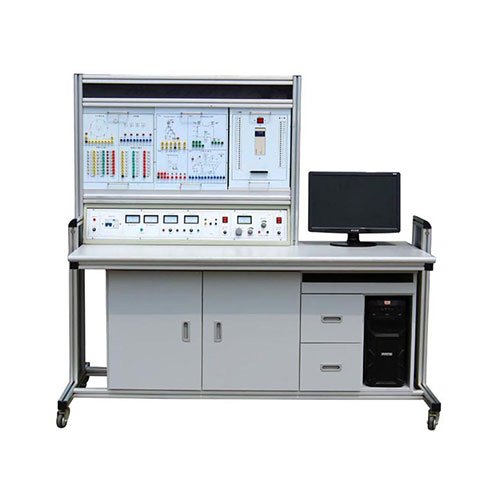
The training device consists of a control panel, training table, main unit training components, training modules (including a rich array of simulated industrial field equipment training objects), frequency converter enclosure, etc.
(I) Functions and Features
1) The experimental table includes:
A. DC voltage: 0~10V adjustable output; DC current: 0~20mA;
B. ~220V output through a safety socket
C. Three-phase four-wire 380V output, indicated by three voltmeters
D. +24V/1A DC regulated power supply output
E. +5V/5A DC regulated power supply output
2) The input and output ports of the PLC main unit and experimental modules are all led to the panel. The experiment uses pluggable self-locking wire connections. Inputs can be connected to analog input switches, limit switches, or photoelectric switches, etc. Outputs can be connected to indicator lights, digital displays, relays, DC motors, and buzzers on the panel. It can also be connected to demonstration devices for practical industrial control applications.
3) The experimental platform adopts a hanging box structure, facilitating the expansion of experimental projects and secondary development by users.
4) PLC Host Configuration: Siemens S7-1500 CPU 1511C-1 PN, 175 KB program, 1 MB data; 60 ns; integrated 2x PN interfaces; integrated 16 DI/16 DO, 5 AI/2 AO, 6 HSC@100kHz
1. All PLC input/output ports are led out to the socket.
5) Training Table: The training table is made of industrial aluminum profile, with a fireproof, waterproof, and wear-resistant high-density board desktop. It adopts an integrated computer desk and training table design. The lower part of the training table has drawers; the left side has a double-door cabinet for storing training modules, the middle has two large drawers for storing tools and materials, and the right side has a computer host cabinet. A keyboard tray is located above the computer host cabinet and drawers, with a beautiful and elegant design.
(II) Experimental Projects
1) PLC Basic Skills Training
1. PLC Cognition Training
2. PLC Simulation Training
3. Jump and Branch Function Experiment
4. Shift Register Experiment
5. Data Processing Function Experiment
6. Differentiation and Bit Manipulation Experiment
7. AND, OR, and NOT Logic Function Experiment
8. Timer and Counter Function Experiments
2) PLC Simulation Control Application Training
19. Quiz Buzzer Control (Priority, Numerical Calculation, with Sound Effects)
20. Sky Tower Light Control (Blinking, Spreading, Flowing Type)
21. Musical Fountain Control (with Sound Effects)
22. Traffic Light Control at an Intersection
23. Water Tower Level Control
24. Automatic Feeding and Loading System Control
25. Four-Section Conveyor Belt Control
26. Assembly Line Control
27. Multi-Liquid Mixing Device Control
28. Automatic Molding Machine Control
29. Fully Automatic Washing Machine Control (with Sound Effects)
30. Automatic Rolling Mill Control
31. Mail Sorting Machine Control
32. Vending Machine Control
33. Robotic Arm Control
34. Four-Story Elevator Control
35. Machining Center Control
36. Stepper Motor PLC Control
3) PLC and Three-Phase Motor Skills Training
1. PLC Control 1) Three-phase asynchronous motor forward and reverse rotation control
2) PLC-controlled three-phase asynchronous motor Y/Δ start control
3) PLC-controlled three-phase asynchronous motor start and stop control
4) PLC and frequency converter integrated application skills training
9) Frequency converter function parameter setting and operation
10) Frequency converter alarm and protection functions
11) External terminal jog control
12) Frequency converter control of motor forward and reverse rotation
13) Multi-segment speed selection frequency conversion speed regulation
14) Frequency converter stepless speed regulation
15) Frequency conversion speed regulation based on external analog quantity (voltage/current) control method
16) Multi-segment speed regulation based on PLC digital quantity control method
5) PLC and touch screen skills training
9) Touch screen indicator light object experiment
10) Touch screen switch object experiment
11) Touch screen data display experiment
12) Touch screen data input experiment
13) Touch screen bar graph object experiment
14) Touch screen object experiment
15) Touch screen moving element object experiment
16) Touch screen static display experiment