- Automobile training equipment series
- Electrical and electronic teaching equipment
- Elevator training series
- Fitter training equipment
- Fluid mechanics experimental equipment
- Hydraulic and pneumatic test bench
- Mechanical teaching equipment
- Robotic automation and mechatronics series
- Welding training equipment

I. Product Introduction:
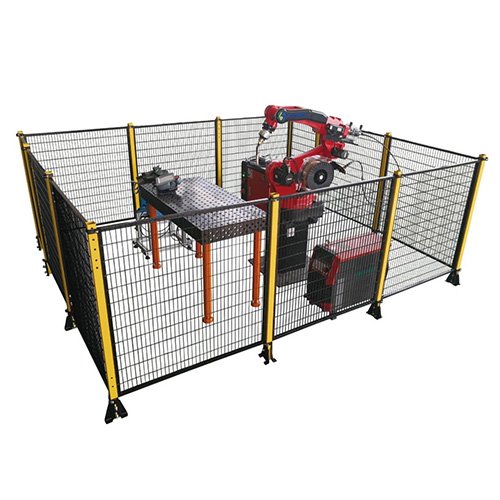
This solution is centered around a 6-axis welding robot workstation and is equipped with a dedicated robot welder, welding condensation system, argon shielding gas, welding positioner, and other supporting equipment. It also features an automated welding control system. Through PLC programming, it automatically controls processes such as material discharging, loading, double-sided welding, and discharging. It is an excellent platform for learning industrial robot welding application and automation technology.
By switching between robotic handling and welding functions, combined with the automated, continuous movement of the material dispensing table and automatic welding positioner, it offers a more comprehensive configuration and functionality than previous training and teaching equipment. It realistically simulates and reflects the robotic welding and industrial control processes, offering a wide range of training content and diverse variations. This is a typical professional skills training and assessment device. Through training and assessment on this device, students can significantly enhance their professional skills. II. Technical Parameters
1. AC Power Supply: Three-phase AC 380 V ±10%, 50 Hz
2. Temperature: -10°C to 50°C; Humidity: ≤90%, no condensation
3. Total Power Consumption: ≤10.0 kVA
4. Dimensions: 3500 mm * 3000 mm * 1850 mm
5. Safety Measures: Equipped with grounding protection, leakage protection, and power-off protection, safety complies with relevant national standards.
III. Product Configuration Parameters:
1. Welding Workpiece Description
Welding Wire Specifications: Ø0.8/1.0/1.2 mm
Weld Types: Flat Welds, Fillet Welds, and Half-Circular Welds
Shielding Gas: CO2
Operating Mode: Manual Loading and Unloading, Robotic Automatic Welding
Overlay Thickness: Depends on process requirements
2. Solution Overview
The welding robot system consists of a welding robot, welding power supply, dedicated robot welding gun, welding positioner and fixture, PLC and electrical control, and safety fence. After the workpiece is manually placed on the fixture, the robot begins automatic welding.
3. Process Flow
The weld seam within 30mm of the workpiece must be free of oil, rust, and other stains, and must meet the dimensional tolerances specified in the workpiece drawing. The system welding workflow is as follows:
1) Preparation: The workpiece is prepared according to the drawing.
2) Workpiece Installation: The robot automatically places the workpiece into station 1 and onto the workbench.
3) Workpiece Positioning: The clamping device automatically clamps the workpiece against the positioner.
4) Robot Front-Side Welding: The robot automatically welds the front side from the set position.
5) Robot Reverse-Side Welding: The positioning table begins positioning, flips to the reverse side, and the robot begins reverse-side welding.
5) Workpiece Unloading: After welding is completed, the robot returns to station 2 to perform welding operations. The operator then reenters station 1 to unload the workpiece.
6) The cycle continues.
4. Main Functions
To ensure welding quality and efficiency, the robot system is equipped with comprehensive self-protection features and an arc welding database. Key functions are as follows:
Original Path Resume: If an abnormal gas flow, wire exhaustion, or temporary pause occurs during welding, the “Resume Last Weld” command can be directly invoked after the fault is resolved. The robot will automatically resume welding from any position.
Fault Detection and Prediction: After an alarm is detected, data is collected from the control unit to infer the fault location and list the most common faults. The replacement sequence is displayed, and diagnostic results are displayed on the computer, which can be viewed on-site using an iPendant. Furthermore, the computer regularly obtains and analyzes operating data from the on-site robot to determine whether the robot is operating normally and to alert the user to any impending faults.
Collision Avoidance: If the robot’s welding torch collides with an external object, it automatically retracts to protect the torch and robot.
Expert Database: By setting the necessary welding conditions in the program, the system automatically completes weld bead formation and adjusts the corresponding welding parameters. Teaching Programming: On-site programming is possible using the robot’s equipped teach pendant. Welding gun oscillation: The robot can perform not only common oscillation patterns such as SIN, zigzag, circular, figure-8, and L-shaped, but also custom oscillation functions tailored to the specific workpiece shape. This increases weld bead width, improves weld strength, and ensures aesthetically pleasing welds.
Status Display: The robot’s teach pendant displays the operating status of the entire robot system, including program status, welding process parameter changes, system parameter changes, robot current position, execution history, safety signals, and alarm logs. This allows customers to stay informed of the robot system’s status and proactively prevent potential problems.
Input/Output Files: System files and teach program files within the robot system can be stored on the memory card within the robot control cabinet or retrieved to an external device. Programs written using offline programming software can also be loaded into the control cabinet. This allows customers to regularly back up system files and restore them to resolve any issues.