- Automobile training equipment series
- Electrical and electronic teaching equipment
- Elevator training series
- Fitter training equipment
- Fluid mechanics experimental equipment
- Hydraulic and pneumatic test bench
- Mechanical teaching equipment
- Robotic automation and mechatronics series
- Welding training equipment
Technical Parameters and Requirements
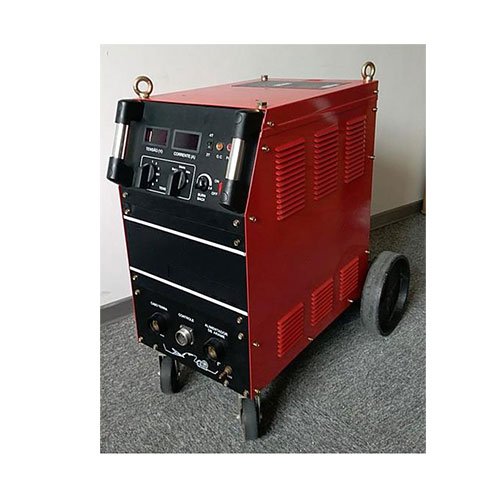
1. Fully digital structure, high integration, and low overall failure rate.
2. Optimized welding characteristics for different materials, gases, and wire diameters, achieving low spatter during short-circuit transitions and high-speed spatter-free welding during high-arc welding.
3. Simple and intuitive operation panel, easy to use.
4. Capable of gas shielded welding, gas shielded spot welding, and manual welding.
5. Features wave control function for better welding results, stable low-current transitions, reduced spatter during high-current welding, constant current arc ignition, and 100% arc ignition success rate. 6. Can be externally connected to a robot or PLC interface, supports DEVICENET
Rated Input Voltage (V) 3PH/380V 50/60Hz
Rated Input Capacity (KVA) 15
Rated Output Voltage (V) 76
No-load Loss (W) 300
Rated Input Current (A) 23.5
Current Adjustment Range (A) 30-350
Voltage Adjustment Range (V) 12-40
Duty Cycle 60%@350A
Power Factor >0.87
Applicable Welding Wire Type Solid/Fluid-cored Carbon Steel and Stainless Steel Welding Wire
Applicable Welding Wire Diameter (mm) φ0.8/1.0/1.2
Cooling Method Air Cooling
Supporting Teaching Software: ★ Employs simulated scenes presented in the form of Flash animation, while also possessing strong interactivity and operability, creating a new teaching and learning model. This training course includes relevant printed instruction manuals and multimedia resources. It is an authentic version with an encryption system and includes the following content:
Part One: Shielded Metal Arc Welding (SMAW);
1. Training Objectives;
2. Welding Arc (Welding process, technological characteristics, arc structure and temperature, static characteristics, and stability);
3. Welding Parameters (Basic requirements for welding power source, welding polarity, electrode diameter, welding current, welding voltage, number of welding layers, welding heat input, bevel form and size);
4. SMAW Operation Techniques (Basic operation techniques, key points for various welding positions);
5. Skill Training Examples (Single-sided welding with double-sided forming at flat welding position for low-carbon steel plate, flat fillet welding at T-joint of low-carbon steel plate, vertical corner welding at T-joint of low-carbon steel plate);
Part Two: Gas Welding;
1. Training Objectives;
2. Principles and Applications;
3. Process and Technology;
4. Equipment and Tools;
5. Skill Training Examples;
6. Defects and prevention measures of joints;
7. Operational safety; Three parts, gas cutting;
1. Training objectives;
2. Principles and applications;
3. Process and technology;
4. Equipment and tools;
5. Skills training examples;
6. Defects and prevention measures of gas cutting;
7. Operational safety;